


Causes Related to the Outer Ear
- Earwax (cerumen)
- Foreign object in the ear canal
- Absence or congenital deformity of the ear auricle
- Congenital closure of the ear canal
- Outer ear infections
- Tumors of the outer ear
Causes Related to the Middle Ear
- Perforation of the eardrum
- Middle ear infection
- Low pressure in the middle ear (due to Eustachian tube blockage)
- Calcification in the ossicles of the middle ear
- Tumors of the middle ear
Causes Related to the Inner Ear and Auditory Nerve
- Inner ear infection (labyrinthitis)
- Damage to the hair cells in the inner ear
- Sudden hearing loss
- Noise-induced hearing loss
- Age-related hearing loss
- Meniere’s disease (increased pressure in inner ear fluids)
- Tumors affecting the auditory nerve
How Is Hearing Loss Treated?
Hearing loss is not a disease itself but a symptom of other underlying conditions. Therefore, the treatment for hearing loss involves treating the underlying condition. Treatments for diseases causing hearing loss are explained in their respective sections. However, some points are worth mentioning here:
- Removal of earwax or foreign objects in the ear canal.
- Middle ear infections are usually treated with antibiotics or other medications. Chronic middle ear infections may sometimes require surgery.
- In otosclerosis, a condition where the stapes bone calcifies, the stapes bone is removed and replaced with a prosthesis.
- Hearing loss related to the inner ear is typically permanent. However, in cases where hearing loss is due to tumors, the tumor may be removed, even if hearing is sacrificed in the process.
What Tests Are Performed?
To determine the cause of hearing loss, the first step is an ear examination. During this examination, any disease in the outer ear or eardrum can be easily seen. The appearance of the eardrum, especially in cases of middle ear infections, provides information about the state of the middle ear. If the examination is normal, the cause of hearing loss is more likely related to the inner ear, but some tests are conducted to confirm this.
These tests include:
- Pure Tone Audiometry: Determines the type (conductive, sensorineural, or mixed) and degree of hearing loss, as well as the affected frequencies. The information obtained here is very valuable for determining the degree of hearing loss.
- Speech Audiometry: Provides information on pathologies in the middle ear, cochlea, auditory nerve, central auditory system, and auditory pathways.
- Tympanometry: A test used to measure middle ear pressure.
- Acoustic Reflex Test: Used to detect calcifications in the ear ossicles by checking the stapedial reflex.
CT (Computed Tomography) or MRI (Magnetic Resonance Imaging): Particularly used to determine the cause of inner ear-related hearing loss.
Tinnitus
Tinnitus is defined as the perception of sound without an external acoustic stimulus. It can take the form of ringing, buzzing, humming, the sound of waves, machine noise, roaring, or the sound of water or waves. The general prevalence of tinnitus is approximately 10-15% in the adult population. Many conditions can lead to or be associated with tinnitus, with hearing loss being the most common.

Other associated conditions include:
- Ear-related causes: Infections, tumors in the ear, brain, or brainstem, hearing loss originating from the inner ear, otosclerosis, earwax, age- or noise-related hearing loss.
- Causes related to the central nervous system: Meningitis, migraine, multiple sclerosis, and epilepsy.
- Head and neck injuries or trauma
- Cardiovascular disorders: Hypertension, orthostatic hypotension.
- Psychogenic causes: Anxiety, depression, emotional trauma.
Tinnitus Threshold Determination Test
In our clinic, pure tone audiometry is used to determine the frequency and intensity of tinnitus. Once the threshold is determined, a mask is applied, and the patient is asked if the tinnitus has disappeared, guiding them to appropriate treatments.
Middle Ear Infection
Acute otitis media is an infection in the middle ear caused by microbes, typically occurring in children and presenting with symptoms like ear pain, fever, fatigue, and irritability.
In young children, acute middle ear infection can lead to restlessness, drowsiness, and feeding difficulties. Older children may experience ear pain and a feeling of fullness in the ear, while fever can occur in children of any age. These symptoms are usually associated with upper respiratory infections such as runny nose, congestion, or cough.
The accumulation of pus in the middle ear causes pain and reduces the eardrum’s vibration, resulting in temporary hearing loss. In severe ear infections, the fluid in the middle ear may start to drain into the ear canal, potentially causing a perforation in the eardrum. This perforation can heal with treatment.
How Common Is Acute Middle Ear Infection?
Research indicates that 75% of all children experience at least one middle ear infection by age three. Acute otitis media is more common in boys than girls.
Is Acute Middle Ear Infection Contagious?
Ear infections themselves are not contagious, but many children develop ear infections following colds or other viral infections, which are contagious.
What Are the Risk Factors for Acute Middle Ear Infection?
Upper respiratory infections can predispose children to acute middle ear infections. Children who attend daycare centers or schools have a higher risk of frequent infections.
Exposure to irritants, like cigarette smoke, can also contribute to the development of acute middle ear infections. Children with cleft palate or Down syndrome are more susceptible to ear infections. Certain issues with the Eustachian tubes (blockage, structural abnormalities, inflammation, etc.) increase the risk of acute middle ear infections.
Children who have had a middle ear infection before six months of age are more likely to experience recurrent infections.
How Is Acute Middle Ear Infection Diagnosed?
There are three criteria for diagnosing acute otitis media:
- Acute onset of infection
- Middle ear effusion (fluid accumulation)
- Middle ear inflammation
Recurrent acute otitis media is defined as having three episodes within six months or four episodes within a year. Currently, there is no specific definitive test for acute middle ear infection. Some tests may be required to diagnose chronic otitis media.
How Is Acute Middle Ear Infection Treated?
The treatment for acute otitis media depends on the child’s age and symptoms. Initially, a 10-day course of antibiotics is often recommended. Despite antibiotic treatment, about 40% of children with middle ear infections may retain fluid in the ear that can lead to temporary hearing loss, lasting from three to six months. In most cases, this fluid resolves on its own.
Children who cannot take oral medications may be given an injection, although a three-day antibiotic course is more effective than a single injection.
In cases of recurrent infections, ear tubes may be recommended to allow fluid to drain from the middle ear. If the child has intense pain and eardrum swelling, surgery may be considered. The eardrum typically heals within a week.
Chronic Middle Ear Infection
Under normal conditions, the Eustachian tube allows fluid to drain through it, preventing accumulation. Chronic middle ear infection develops over time, usually starting with unresolved chronic middle ear effusion (fluid). Bacteria can infect the fluid that remains for an extended period.
After an acute infection, fluid (effusion) can remain behind the eardrum for up to three months, which may lead to chronic middle ear infection.
Bacteria in chronic middle ear infections often differ from those in acute infections. Therefore, anything disrupting the function of the Eustachian tube can cause chronic middle ear infection.
Chronic middle ear infection can lead to ongoing damage in the middle ear and eardrum. It usually starts without pain or fever, but pressure or throbbing in the ear can persist for months.
What Is the Effect of Chronic Middle Ear Infection on the Eardrum?
The eardrum (tympanic membrane) is composed of three delicate but strong layers. Chronic middle ear infection can cause weakening and perforation in the eardrum. Eventually, the eardrum loses its strength and begins to collapse into the middle ear cavity.
When the eardrum collapses, it attaches to structures in the middle ear, such as the ossicles (ear bones) or the surrounding walls of the middle ear cavity. This interferes with sound transmission and can reduce hearing.
How Is Chronic Middle Ear Infection Diagnosed and Treated?
Some tests are necessary to diagnose chronic middle ear infections. Hearing tests are performed to determine the degree of hearing loss.
In cases where middle ear pressure increases, a pressure test is conducted. A CT scan may be used to assess the severity of the infection and the need for surgery.
How Is Chronic Middle Ear Infection Treated?
Initially, antibiotics may resolve the infection. If there is a perforation in the eardrum, topical antibiotic drops may be recommended. However, if there is scarring in the eardrum or ossicles, antibiotics alone may not suffice. In such cases, surgery is performed to repair the eardrum, remove infected tissue and scar from the middle ear and mastoid bone.
The primary goal of chronic middle ear surgery is to remove all infected tissue to prevent recurrence of the infection. The secondary goal is to reconstruct the middle ear cavity with a healthy eardrum. After these procedures, hearing can be restored.
It may seem odd that hearing restoration is the final goal, but if the first two goals are not achieved, and the infection is not treated, any efforts to improve hearing will be wasted since a new infection will once again damage hearing.
Ears with Perforated Eardrum
In these patients, the infection in the middle ear has subsided, and there is no active inflammatory process in the middle ear. However, as a sequela of the infection, the eardrum has remained perforated. This perforation may be very small, or the entire eardrum may be missing. Such ears are always at risk of reinfection. When an infection occurs, discharge from the ear begins. These patients typically experience hearing loss of about 20-40 dB due to the perforation. If the bones in the middle ear are also damaged, hearing loss may be more severe. Early perforations of the eardrum may heal and close spontaneously. However, the longer the duration, the lower the chance of spontaneous closure; if it persists for over 3 months, spontaneous closure is unlikely. In such cases, surgical repair of the eardrum with a procedure called tympanoplasty is necessary.
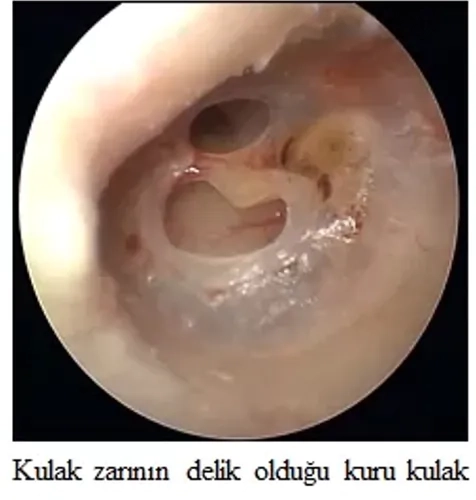
Draining Ears with Perforated Eardrum
In these patients, the eardrum is perforated, and an active inflammatory process is present in the middle ear. This typically results in a foul-smelling discharge from the ear. Patients experience conductive hearing loss of around 30-60 dB. These patients are more likely to have damage to the ossicular chain compared to those with dry ears.
The primary goal for these patients is to clear the infection with medication. To achieve this, oral antibiotics are administered alongside antibiotic and corticosteroid ear drops. If the infection is cleared and the ear becomes dry, the perforation in the eardrum can then be repaired with tympanoplasty surgery. However, if ear discharge persists despite medical treatment, surgical intervention is mandatory. Chronic infection in the middle ear can lead to serious problems, such as erosion of the ossicles, meningitis, brain abscess, and permanent hearing loss. In these cases, a procedure called tympanomastoidectomy is performed to clean the infection in the middle ear and repair the eardrum.
Fluid Accumulation in the Ear (Serous Otitis Media)
Middle ear inflammation that occurs without infection is known as serous otitis media. Enlarged adenoids, sinus diseases, acute otitis media, allergies, and, in rare cases, tumors can cause serous otitis media.
When the Eustachian tube fails to function properly, the ear cannot ventilate, leading to fluid accumulation in the middle ear. This condition may result in hearing loss and a feeling of fullness in the ear.
Initially, serous otitis media is treated with antibiotics. However, if there is no improvement, surgical treatments such as inserting a ventilation tube in the eardrum are considered. If thinning of the eardrum is observed, surgical intervention is performed directly without antibiotics. If the issue is related to the adenoids, removal of the adenoids may also be beneficial in the treatment.

Acoustic Trauma
“Acoustic trauma” is hearing loss caused by exposure to loud noise. If the noise is extremely loud or prolonged, it can lead to tinnitus (ringing), humming, and sensorineural hearing loss in the inner ear.
Acoustic trauma is one of the most common causes of hearing loss and tinnitus.
Sudden noise from firearms and explosions, like those from guns, rifles, and cannons, can cause acoustic trauma. For some people, even a single explosion can be enough to cause acoustic trauma. Generally, the stronger the explosion, the greater the hearing damage. Explosions in closed spaces are more harmful than those in open air, and underwater explosions cause even more damage to the ear than those in the air.
Hearing loss usually begins in high frequencies, and tinnitus, or ringing/humming in the ears, is almost always present.

Can Ears Get Used to Noise?
There is no such thing as “getting used to” noise. The extent of damage varies from person to person. If the noise is very intense and prolonged, it causes more damage to the nerve cells in the inner ear, affecting more auditory nerves. It is impossible to revive dead nerve cells; the damage is permanent, leading to gradual hearing loss. In noise-induced damage, although the current condition cannot be reversed, further progression can be prevented by avoiding excessive noise and with proper treatment.
How Can Harmful Noise Levels Be Recognized?
People’s sensitivity to noise varies.
- If you have to shout to hear yourself,
- If the noise causes pain in the ear,
- If there is ringing in the ear,
- If you experience slight hearing loss for a few hours after noise exposure, the noise could be damaging to your ears.
How Can Harmful Noise Levels Be Recognized?
The intensity or loudness of sound is expressed in “decibels.” Frequency refers to the number of vibrations per second of the sound. Sound is perceived as “low (bass)” at low frequencies and “high (treble)” at high frequencies. Experts agree that continuous exposure to noise above 85 decibels can be dangerous. When hearing loss begins, the ability to hear high frequencies decreases first. Loss at high frequencies can also distort the quality of sound, making it harder for people to fully understand what they hear even if they can still hear it. Those with hearing loss often have difficulty distinguishing similar sounds.
Does the Duration of Loud Noise Exposure Affect Hearing Loss?
Absolutely. The longer the exposure to loud noise, the more damage it causes to hearing. Additionally, the closer one is to the noise source, the greater the intensity and discomfort of the sound.
Every gunshot can damage the hearing of nearby people. Long-barreled firearms and cannons, due to their higher noise intensity, are among the most dangerous. However, even toy guns can damage hearing if close enough.
Recent studies on young people have found significant issues in those who frequent very loud discos and listen to loud music with headphones.
Should Hearing Protectors Be Used?
Those working in very noisy environments should use hearing protection. Additionally, it should be used when operating loud machinery or during gunfire.
At workplaces, exposure to noise levels of 85 dB or above for more than eight hours a day should not be permitted. If the average noise level exceeds 90 dB over eight hours, hearing protection is necessary.
What are Hearing Protectors and How Effective Are They?
Headphones and earplugs reduce the intensity of sound reaching the eardrum.
Earplugs are inserted into the outer ear canal and reduce the intensity of sound, preventing damage. For effectiveness, they must fully block the ear canal. They come in various sizes and types. It is essential to ensure they are clean and do not irritate the outer ear canal.
Types of Earplugs
- Over-the-ear headphones: These cover the entire ear and are connected with a headband over the top of the head. They must tightly seal the ear for effective protection.
- Acrylic molds: These are solid molds without holes, similar to hearing aid molds, covering the concha and ear canal.
- Malleable earplugs: Made of silicone, sponge, or petroleum jelly-coated cotton, used to plug the outer ear canal.
Earplugs and full-ear headphones reduce sound intensity by 15 to 30 dB. Earplugs are generally more effective at low frequencies, while full-ear headphones are more effective at high frequencies.
When used together, they provide an additional 10-15 dB of protection. Combined use is recommended for noise levels above 105 dB.
Simple cotton, sponge, or paper earplugs inserted into the ear canal are not very effective, reducing noise by only about 5-7 dB.
What Can Be Done If Noise Has Already Caused Hearing Damage?
Hearing loss typically develops over years. It is painless and gradual, so you may not notice it immediately. Hearing loss is more easily detected if accompanied by tinnitus or humming. Difficulty understanding speech in noisy environments can indicate the onset of high-frequency hearing loss, warranting a hearing test.
If a middle ear infection lasts longer than 3 months, it is classified as chronic otitis media.
Chronic ear infections and eardrum perforations are generally categorized into three main groups:
- Dry ears with perforated eardrum
- Discharging ears with perforated eardrum
- Ears with cholesteatoma
Barotrauma
Barotrauma is a condition caused by pressure differences between the inner and outer sides of the eardrum. The air pressure in the middle ear is typically the same as the external air pressure. The Eustachian tube connects the middle ear, nose, and upper throat.
Swallowing or yawning opens the Eustachian tube, allowing air to flow in and out of the middle ear, keeping air pressure equal on both sides of the eardrum. If the Eustachian tube is blocked, a pressure difference occurs between the middle ear and the outer side of the eardrum, resulting in ear congestion.

What Causes Barotrauma?
Many people experience barotrauma from time to time. Ear congestion can occur during situations that cause altitude changes, such as flying, diving, or driving in mountainous areas. If there is nasal congestion due to allergies, a cold, or an upper respiratory infection, the likelihood of ear congestion is higher.
Eustachian tube blockage can also be congenital (present before birth) or due to throat swelling.
Symptoms of Barotrauma:
- Dizziness
- Discomfort or pain in one or both ears
- Mild hearing loss
- A feeling of fullness or blockage in the ears
If barotrauma is severe or prolonged, additional symptoms may include:
- Ear pain
- A sensation of pressure in the ears (like being underwater)
- Moderate to severe hearing loss
- Nosebleed
What is the Course of the Condition?
Barotrauma is generally benign and can heal without medical intervention. Hearing loss caused by this discomfort is usually temporary.
Possible complications include:
- Acute ear infection
- Hearing loss
- A torn or perforated eardrum
When to Seek Medical Attention?
Try to alleviate ear congestion using the techniques mentioned. If the problem persists and particularly if you experience any of the following symptoms, consult a healthcare facility:
- Ear discharge or bleeding
- Fever
- Severe ear pain
How is Barotrauma Treated?
To relieve ear pain or discomfort, the Eustachian tube should first be opened to reduce the pressure. This can be done by chewing gum, taking a deep breath and then blowing gently while pinching the nostrils and closing the mouth, eating candy, or yawning.
While flying, avoid sleeping during descent. Offer liquids to babies and children during descent.
Divers should be cautious when descending and ascending in water. Diving with allergies or respiratory infections can be dangerous. If your condition does not improve within a few hours or if the trauma is severe, medical intervention may be necessary.
The following medications may be recommended in treatment:
- Antihistamines: Oral or nasal decongestants (If planning to dive, consult your doctor before using decongestants).
- Steroids: These drugs may help relieve nasal congestion and open the Eustachian tube. If the trauma is severe, antibiotics may be used to prevent an ear infection.
Surgery: If these measures do not open the Eustachian tube, surgery may be required. A small incision in the eardrum (myringotomy) can equalize the pressure by releasing air. However, surgery is rarely needed in barotrauma treatment. If you frequently experience altitude changes or are prone to barotrauma, you may consider ear tube surgery.
What is Acoustic Neuroma (Vestibular Schwannoma)?
Acoustic neuroma is a benign tumor that develops on the hearing and balance nerves between the inner ear and the brain. The balance nerve, which comes from the semicircular canals in the inner ear, and the hearing nerve, which originates from the cochlea, travel together with the facial nerve that controls facial movement from the inner ear toward the brain. This tumor forms in the area where these three nerves pass to the brain. It grows very slowly, so symptoms may take years to become noticeable.
The first symptom that usually appears is tinnitus (ringing in the ear). As the tumor grows, it affects the hearing nerve, leading to hearing loss. Dizziness is generally not observed, though a feeling of imbalance may occur.

Diagnosis of Acoustic Neuroma
Acoustic neuroma is diagnosed through hearing tests, balance tests, and imaging techniques such as computed tomography (CT) or magnetic resonance imaging (MRI).
Treatment of Acoustic Neuroma
If the tumor reaches a certain size, it is removed surgically. Various methods have been defined for the surgical approach and techniques used. The main risks associated with the surgery include facial paralysis and hearing loss.
Balance Disorders
Benign Paroxysmal Positional Vertigo (BPPV) (Crystal Displacement)
Commonly known as “crystal displacement” among the public, BPPV is the most frequently observed vestibular disorder and the most common ear-related cause of vertigo. While it can occur at any age, it is most frequently observed in adults, with women experiencing it 2-3 times more often than men. Patients report short, intense bouts of dizziness triggered by angular head movements.
The treatment for BPPV involves determining which canal is affected through diagnostic tests, followed by a maneuver tailored to the affected canal. These maneuvers are the most commonly used treatment method. Additionally, balance physical therapy exercises (vestibular rehabilitation) and pharmacotherapy or surgical treatments may also be utilized.

Meniere’s Disease
Meniere’s disease is also known as idiopathic endolymphatic hydrops. It is characterized by two or more spontaneously occurring episodes of dizziness lasting between 20 minutes and 12 hours.
In the affected ear, a sensorineural hearing loss in the low and middle frequencies can be observed before or during at least one of the crises. Additionally, a sense of fullness, pressure, and ringing in the affected ear are common. Treatment is generally managed medically.

Vestibular Neuritis
Vestibular neuritis is believed to be caused by viruses and is characterized by sudden onset, severe dizziness that can last for days (1-7 days) accompanied by nausea and vomiting, without any hearing symptoms.
It is the third most common peripheral type of vertigo after BPPV and Meniere’s disease. It is most commonly observed in individuals between the ages of 35-50.
The treatment for vestibular neuritis involves short-term medical therapy, followed by vestibular rehabilitation.

Vestibular Migraine
Vestibular migraine is a condition causing dizziness, with periodic attacks similar to those in regular migraines, sometimes accompanied by headaches. Besides dizziness, symptoms include sensitivity to light and sound, visual flashes or floaters, and intensifying pain with physical activity. The attacks may also be triggered by the consumption of coffee, chocolate, dairy products, and similar triggers.

Ear Disorders Requiring Surgery and Hearing Restoration Surgeries
- Cholesteatoma
- Otosclerosis
- Tympanoplasty (Membrane and Hearing Repair)
- Cochlear Implantation and Bone-Anchored Hearing Aid Surgery
 Rating


